I have two new blog posts at the kenyon review for your reading pleasure.
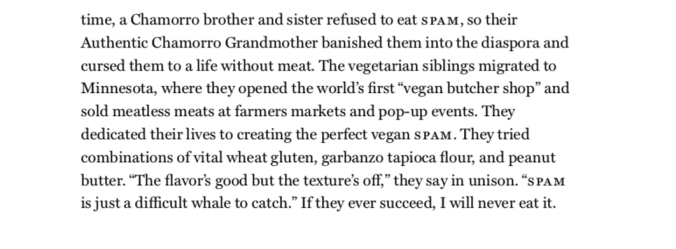
the first is: “Refrigeration, The Pacific Body, and Other Perishables”
the second is: “Mata’pang, Migration, and the Case of the Stolen Mangos”
feel free to share
I have two new blog posts at the kenyon review for your reading pleasure.
the first is: “Refrigeration, The Pacific Body, and Other Perishables”
the second is: “Mata’pang, Migration, and the Case of the Stolen Mangos”
feel free to share
my newest blog post is now live at the Kenyon Review Blog. Read it here.

The Poetry and Poetics Colloquium is thrilled to announce that poet and literary scholar Craig Santos Perez will be joining us for an evening reading on Wednesday, May 1st, and a lunchtime workshop on Thursday, the 2nd.
Reading
Wednesday, May 1
5:00 p.m.
Kresge 2-359
Workshop
Thursday, May 2
12:00 p.m.
Kresge 2-425

For the past few years, Iʻve been blogging away from this, my home blog.
In 2010, I guest blogged for The Poetry Foundationʻs Harriet Blog here.
In 2011, I guest blogged for JACKET2 literary magazine here.
In 2012, I returned to blog for The Poetry Foundation here.
And thus far in 2013, Iʻve been blogging for the Kenyon Review here.
Not sure where the blog writing adventures will take me next, but I hope you will be interested in reading my work. Thanks! Craig
dear blog readers, wanted to let you know that i have been blogging once a week over at the KENYON REVIEW online site. i have published 14 blog posts thus far, ranging in theme and style. hopefully you will enjoy reading them and feel free to share:
Here are the posts in three sections:
I hope everyone is well,
craig
A few weeks ago, I attended the Transnational American Studies and Oceanic Archive conference at Hong Kong University. This conference featured many scholars from the U.S., the Pacific, and Asia, who work in the fields of transnational American, Asia and Pacific studies. (check out the entire schedule here. )
The paper I presented, “The Transterritorial Turn and the Decolonial Archive of Chamoru Poetry,” argued for the importance of studying territories, such as my home island of Guahan (Guam), to more fully understand the formations of America, Asia, and the Pacific. This scholarly work becomes even more pressing considering the recent turn in U.S. foreign policy towards the Pacific—in what Hillary Clinton has deemed “America’s Pacific Century” as it faces off with the “Asian Century.” Guam is at the center of these colliding forces as they seek to dominate the 21st century.
My paper then focused on the role that Chamoru poetry plays in asserting the possibility of a Chamoru century. Specifically, I examined the work of several Chamoru poets and how their work contributes to the decolonization movement. Their poems, I argue, reveal the complexity and injustice of Guam’s territorial status as an unincorporated territory of the U.S., exposing the ruptures and contradictions of a celebratory narrative of America.
Chamoru poetry gets very little attention within the larger field of American literature, and Guam is a little-known place in universities in the U.S., Asia, and even the Pacific. So I am happy that my work as a scholar allows me to travel and bring awareness to my people’s literature and political struggles.
In addition my scholarship, my poetry allows me the same opportunities to travel and raise awareness. On Sunday, I will travel to London to participate in Poetry Parnassus, a weeklong festival coinciding with the London 2012 Olympics. This event, sponsored by London’s Southbank Centre, will feature a poet from almost all of the 204 competing Olympic countries, including Nobel Laureates Seamus Heaney (Ireland) and Wole Soyinka (Nigeria) and former poet laureate Kay Ryan (USA), among others.
I am deeply honored to have been chosen to represent my home island, one of several colonized countries competing in the Olympics. For more on the history of Guam and the Olympics, read my post at the Poetry Foundation here. For some thoughts on my involvement with this event, see my interview here.
While in London, I will participate in four events (listed below). As I prepare, I feel thankful that these events touch upon so many different concerns in my poetry, from language issues to Pacific aesthetics, from the avant-garde to eco-poetry. Just as it has been important for me as a scholar to be multi-disciplinary, it is important to me as a poet to be multi-dimensional.
Panel Discussion
Wednesday 27 June
TITLE: Free The Word!: Speechless: Minority languages, marginalised voices
2:30pm – 3:30pmA discussion bringing together writers working in marginalised languages, as well as academics in the area of linguistic human rights, to examine issues around linguistic diversity, multilingualism and language death. Will explore whether minority literatures can continue to flourish in the face of ever increasing globalisation, and why linguistic heritage matters to writers now more than ever.
David Shook, Pedro Perez-Sarduy, Craig Santos Perez
Chaired by Nicholas Ostler, Chairman of the Foundation for Endangered Languages and author of Empires of the Word.
In partnership with PEN InternationalThursday 28th June
TITLE: WordPlay: Pacifica
SUBTITLE: Poetry from 7 of the 30,000 Pacific Islands
White Room
7.00pmDiscover the poetry and spoken word scene of the Cook Islands, Guam, Kiribati, the Marshall Islands, New Zealand, Samoa and Tonga with readings from Tusiata Avia, Audrey Brown-Pereira, Kathy Jetnil-Kijiner, Selina Tusitala Marsh, Karlo Mila, Craig Santos Perez and Teresia Teaiwa.
Hosted by Rebecca Fenton.
Saturday 30th June
TITLE: Maintenant: Celebrating the Experimental & Avant Garde
White Room
7pmAs Poetry Parnassus sweeps the world in its scope, so the festival brings together many poets, from both the UK and beyond, who are engaged in the ongoing struggle with form, medium and methodology in poetry. This event serves to shine a light on those truly breaking new ground, who feel a responsibility to the great seminal movements of the 20th century and wish to see poetry as a mode of expression that cannot be accused of being stilted and generic, and cannot be bound to one style or tone. True innovators, experimentalists and avant gardists, this event showcases those who make poetry in the 21st century pluralist, dynamic, vibrant and open to the future of language and form. Poets include: James Wilkes, Holly Pester, Kirsty Irving, Sam Riviere, Vahni Capildeo, SJ Fowler, Craig Santos Perez, Audrey Brown-Pereira, Chen Li, Rocío Cerón, Zahir al-Ghafri and Chris McCabe
Panel Discussion
Sunday 1st July
TITLE: Environmentalism and Eco-Poetry
QUEEN ELIZABETH HALL FRONT ROOM
2 – 3pmWhat effect does global warming, globalisation and natural disasters have on pastoral and nature poetry? A reading and discussion with John Kinsella, Ak Welsapar, Craig Santos Perez, Teresia Teaiwa and Kathy Jetnil-Kijiner
In between the Hong Kong trip and the upcoming London trip, I was able to work on some activism. As some of you know, Guam has a Decolonization Committee. With the renewed effort to discuss Guam’s political status and push towards a plebiscite, various task forces have been formed to educate people about the political options for Guam’s future. One of these task forces is the Independence Task Force, led by Chamorro scholar, poet, education, and activist Michael Lujan Bevacqua.
Even though I live in the diaspora, it is very important to me to engage with the decolonization movement back home. In my case, writing poetry and scholarship has been a way for me to contribute to the movement since my words can travel beyond my body.
One task of the Independence task force is to revise a twelve-year old position paper on the political option of Independence, and then to design and execute an educational campaign on what Independence would mean for Guam. I volunteered to help write/revise the section of the position paper that focused on the international legal instruments supporting independence, the meaning of independence for Guam, the benefits of independence in the Pacific, and other examples of small independent Pacific island nations. The main thrust of this section is to prove that independence is a viable option for our future; personally, I believe it is the only option that will ensure the Guam will even have a future.
Writing this part of the position paper on the heels of Samoa’s 50th anniversary of independence was very inspiring to me. Envisioning what Guam would be like as an independent, self-determining, self-governing country activated my imagination and made me feel hopeful about the possibility. Doing this kind of activist writing was a powerful way for me to move from the scholarly writing I presented in Hong Kong to the poetic writing I will perform in London. What weaves these strands together for me is the power of words to raise awareness, transform, circulate, empower, educate, and inspire.
If you’d like to learn more about the Independence Task Force and its forthcoming activities, or if you’d like to volunteer or contribute financially, please check out these two posts from Michael Lujan Bevacqua (on Summer Plans for the Task Force, on the vision of independence, and on the formation of the task force).
To honor my Catholic upbringing, I will be reading at three saintly universities in California this week: University of California, San Diego; California State University, San Marcos; and San Francisco State University. If you are free and in the area, please come! If you know folks in the area who might be interested, please help me share the word.
1) 4/25/12: University of California, San Diego, with Susan Schultz, on Wednesday, April 25, 2012 4:30-6:00 p.m. at the Visual Arts Facility: Performance Space. Info here.
2) 4/26/12: California State University, San Marcos as part of their Community and World Literary Series, on Thursday, April 26 at 7 p.m, with Susan Schultz. The reading will be held on the Cal State San Marcos campus in Markstein 125. The event is free and open to the public, but there is a fee for on-campus parking. More info here.
3) 4/28/12: SATURDAY, APRIL 28th, 7:30pm, at the historic UNITARIAN CENTER (1187 Franklin (at Geary)), sponsored by the Poetry Center of San Francisco State University. Please come if you can and PLEASE SHARE: Aaron Shurin and Craig Santos Perez! 7:30 pm @ Unitarian Center, 1187 Franklin (at Geary), $10. More info here.
I Tinituhon from Guampedia on Vimeo.
I Fa’fa’någue-ta, Our Teacher from Guampedia on Vimeo.
Matto Saina ta as Hurao from Guampedia on Vimeo.
kantan chamorrita:
Kantan Chamorrita from Guampedia on Vimeo.
~
~
Time Magazine Blog: “Guam: An Early Casualty of U.S. China Tensions?”
Guampedia entry on “Kulepbla: Snake”
“Modern Hawaiian writing is part of this resisting and reconstructing process. Consciously anticolonial, my own work is also consciously indigenous. Like most Native people, I do not perceive the world of creative writing as divided into categories of prose and poetry or fiction and nonfiction. Nor do I imagine myself crossing from political resistance into artistic creation and then back again. Life is a confluence of creativities: art is a fluid political medium, as politics is metaphorical and artistic.” Haunani-Kay Trask, “Writing in Captivity: Poetry in a Time of Decolonization”
~
Guam Inifresi (Pledge of Allegiance) by Bernadita Camacho Dungca, 1991. Song performed by Zach Lujan:
~
Inifresi
Ginen I mas Takhelo’ gi Hinasso-ku
I Mas Takhalom gi Kurason-hu yan
I Mas Figo’ na Nina’siña-hu, hu
Ufresen Maisa yu’ para bai hu
Prutehi yan Difende I Hinengge,
I Kottura, I Lengguåhi, I Aire I Hanom yan
I Tano’ Chamorro ni’ Irensiå-ku Direchu Ginen
as Yu’os Tåta. Este hu Afitma gi hilo’ I
Bipblia yan I Banderå-hu, I Banderan
GUÅHAN
~
Hurao Return Home (featuring Jay Pascua):
Melvin Won-Pat Borja at DEIS hearing:
Kisha Borja-Kicho’cho’:
Team Guahan at Brave New Voices (2):
Erica Benton: